
Your assessment schedule showed up in the mail and the number went up. Before you write anything, know this: the strongest protest usually has nothing to do with what your neighbor’s house sold for. It has to do with whether the county’s record of your house is correct.
I spent years as an appraiser. I have made the adjustments the assessor is supposed to make, and I have seen what goes wrong. Here is how to protest in the order that actually works.
What Wyoming is really taxing
Two numbers get mixed up all the time. Wyoming assesses residential property at 9.5% of market value. So the assessed value on your schedule is not what your house is worth. It is a fraction of what the county thinks it is worth.
Where does the county’s number come from? Not from a person walking your street. Wyoming runs a computer system called CAMA in all 23 counties. It builds your value like this:
- Start with your land value.
- Add what it would cost to rebuild your house today, using standard cost tables, then subtract depreciation for age and wear.
- Apply a market adjustment factor for your property type and area, worked out from local sales.
Read that middle step again. The system starts from cost to build. Cost to build is not market value, and it never has been. The market adjustment factor is the county’s attempt to close that gap. That gap is where most protests live.
And here is the part most people never realize. Nobody compared your house to specific houses that sold. The cost side accounts for your features, but the market only enters as one factor applied across your whole neighborhood. There is no line anywhere that says the place two streets over sold for this, and yours is different in these ways.
So anything that sets your property apart from its neighborhood is something the model cannot see. A busy road. A bad view or no view. An awkward lot. A layout nobody wants. The system has no way to know, and that is exactly where one property owner with real comparable sales can make a case.
Why this costs more than tax
An over-assessment does not stay in your tax bill. It leaks.
The online estimates pick it up. Then a seller sees that number and believes it. Then an agent pricing the house reaches for the same figure, because it is right there and it looks official.
I have seen a house priced off its assessed value when the only two genuinely comparable sales in the file both said about a hundred thousand dollars less. The assessment won the argument. The house sat.
An assessed value is not a list price. It came out of a cost model with an area factor laid over the top, and it is a fraction of market value by design. Two closed sales on your own street are more accurate than any assessment, any online estimate, or any opinion.
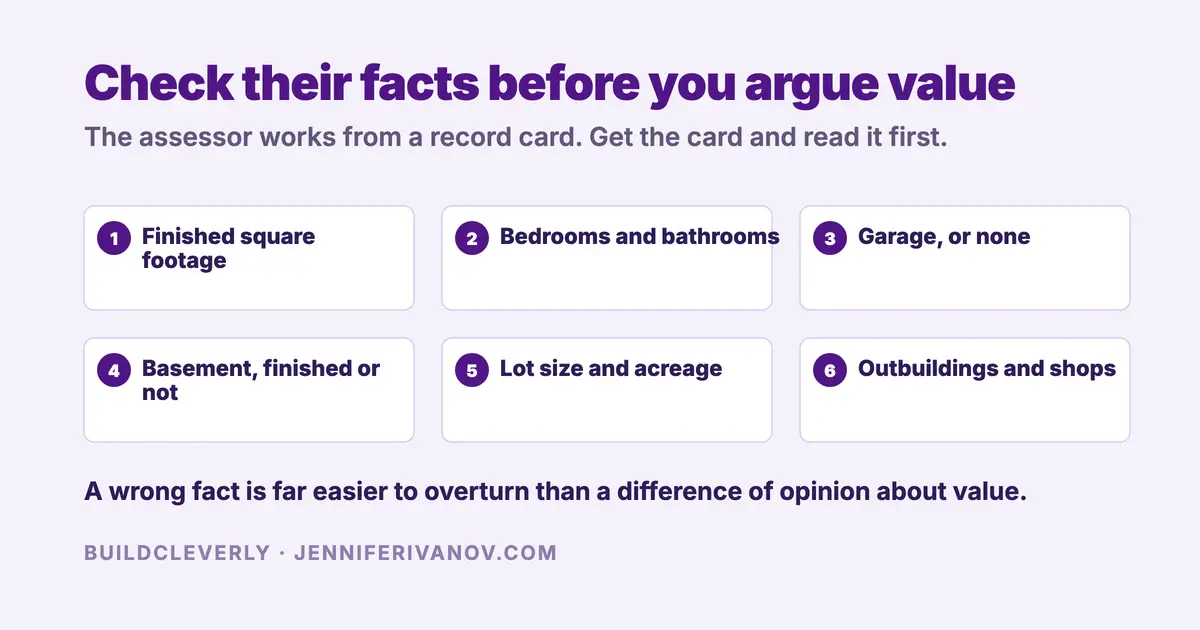
Step 1: Check their facts before you argue value
This is the step people skip, and it is the easiest one to win.
Years ago I pulled the public record on a house before going out to appraise it. The assessor had it at 1,700 square feet with a garage. I got there, measured, and the house was about 700 square feet. A two bedroom, one bath. Nothing had been torn down. There was no sign a wing had ever existed. More than half the house on that record simply was not there, and the owner had been paying on it.
That is not a valuation argument. That is a factual error, and you do not need to be an appraiser to find one. Pull your property record and check it against your actual house:
- Square footage of finished living area
- Bedrooms and bathrooms
- Garage: attached, detached, how many cars, or none
- Basement, and whether it is finished
- Year built
- Lot size and acreage
- Outbuildings, shops, barns
- Quality grade and condition
Take a tape measure to your own house. If the record says you have something you do not have, stop right there. That is your protest, and it is a far easier conversation than arguing about value, because you are not asking anyone for a judgment call. You are showing them their data is wrong.
Step 2: Ask how they got the number
You are allowed to ask the assessor for the comparables and the reasoning behind your value. Ask. You cannot argue with a number you do not understand.
When you get it, look at the cost side as well as the sales side. Is the quality grade right? A standard build should not be graded as custom. Is the depreciation right for the age and condition of the house? If your roof is at the end of its life and your kitchen is original, that is not a house in average condition.
Step 3: Build your comparables properly
Here is the mistake almost everyone makes: “the house next door sold for $100,000 less than my assessment, so I am over-assessed.”
That house next door may sit on a smaller lot. It may be smaller inside. It may be in disrepair. A raw sale price proves nothing on its own. You have to lay the comparables out and adjust them for the differences, the way an appraiser would.
Stay inside your market area
A market area is not a radius on a map. It is an area buyers treat as one place, and its edges are usually things you can see. North of the tracks and south of the tracks. The east side and the west side. Older homes on one street and newer homes on the next. Sometimes a market area is half a mile across. Sometimes it is two blocks.
There is a name for going outside it to find the sales you want: hopscotching. If usable sales exist inside your market area, you are not supposed to skip past them to reach better ones further out. Fannie Mae, Freddie Mac and HUD all have rules against it, and the rule exists because the temptation is real.
It is not an absolute ban. If nothing in your market area has sold, you may have to go further out, and then you make additional adjustments for the differences, including location. The rule is about order of preference: when usable sales exist inside your market area, those are the ones to use.
This cuts both ways. Look at where the assessor’s comparables came from. If they reached outside your market area while sales inside it were available, say so.
Use sales that actually closed
Not asking prices. Not active listings. Anyone can ask any number. Use sales that closed.
The most recent sales are the best ones. Beyond six months you start to lose ground, though in a slow market, or in a place where very little sells, going out to twelve months is reasonable. Say why you had to.
Pick houses that are actually similar
Do not compare a 1,000 square foot house to a 3,000 square foot house. The adjustment needed to bridge that is so large that the comparison stops meaning anything.
For years the rule of thumb was 10% on any single line, 15% net, and 25% gross. Fannie Mae formally retired those thresholds in 2014, because appraisers had started writing to the limits instead of to the market. But they remain a good gut-check. If you are making a 40% adjustment to force a house to fit, you picked the wrong house. Find a better one.
How adjustments actually work
An adjustment is a plus or a minus applied to a comparable sale to account for a way it differs from your property. If the comp has something yours does not, you adjust the comp down. If yours is better, you adjust the comp up.
So where does the dollar figure come from? There is a method, called paired sales, and it is worth understanding even though it almost never works perfectly.
In theory you find two sales that are identical in every way except one feature. Whatever is left in the price difference is what the market pays for that feature.
In practice you will almost never find two properties that are identical except for one thing. Something is always different. So you look at what the market is doing across several sales and you make an estimate. That is the honest word for it. An adjustment is an estimate, informed by the market, and it is never exact.
This is why the result is called an estimate of market value. Anyone who tells you they have calculated your value to the dollar is selling you something.
What a pool taught me
I worked an area once where the houses lined up almost perfectly. Square footage was close. Bedrooms and baths matched. Ages were similar, conditions were similar, lot sizes were similar. The only real difference between one group and the other was a swimming pool.
The houses with pools were selling for roughly $5,000 to $10,000 less.
Not more. Less. So the correct adjustment for a pool in that market was downward. Buyers there saw maintenance, insurance and a fence to keep children away from, and they paid less for it.
That is the whole point of paired sales. Nobody could have guessed that figure, and plenty of people would have assumed a pool adds value. The market said otherwise, and the market is the only thing that counts. It only worked because everything else about those houses was so close together.
When a property is unusual, that clean comparison is not available, and adjustments become far more subjective. Say so honestly rather than inventing precision you do not have.
The deadline in Wyoming, and how to file
This part is not flexible, so put it on the calendar.
- Assessment schedules are mailed on or before the fourth Monday of April.
- You have 30 days from the mail date on your schedule to file a statement with the Assessor saying why you disagree. That is Wyoming Statute 39-13-109.
- Start informally. Talk to the Assessor’s staff first. Plenty of protests end there, especially the factual ones.
- In Park County you can pick up an application at the Assessor’s office or the County Commissioners’ office at the courthouse in Cody. The Assessor’s office is 307-527-8650.
- If it goes to a hearing, both sides must exchange evidence and witness lists at least 30 days beforehand.
The 30 days runs from the mail date, not from the day you opened the envelope. If you travel, or you are away for part of the spring, that is a short window.
What to actually put in writing
Keep it short, factual and easy to check. The person reading it has a stack of these to get through.
- Who you are, the property address, and the parcel or account number from your schedule.
- What you believe the value should be, and that you are asking for a review.
- Any factual errors in the record, with evidence. Your own measurements. Photographs. A sketch.
- Your comparable sales: address, sale date, sale price, size, age, condition, lot size.
- Your adjustments, with a sentence for each saying where the number came from.
- Your conclusion, and a polite request for a fair review.
What the assessor wants to see is not a complaint. It is genuinely similar properties, in your own market area, close by, adjusted up or down for the ways they are better or worse than yours, leading to a fair number. Give them that and you are having a different conversation than most people who walk in.
One last thing
A protest is not an accusation. Mass appraisal values thousands of properties from a computer record, and a computer record can say your house has 1,700 square feet when it has 700. Nobody drives past to check. That is your job, and you are the only person who can do it.

Author: Jennifer Ivanov
Jennifer Ivanov built spec homes in California before moving to Wyoming, and has built homes here. She has valued property as an appraiser, arranged financing as a mortgage broker, and represented buyers and sellers as a licensed broker. California DRE Lic #00993276.