
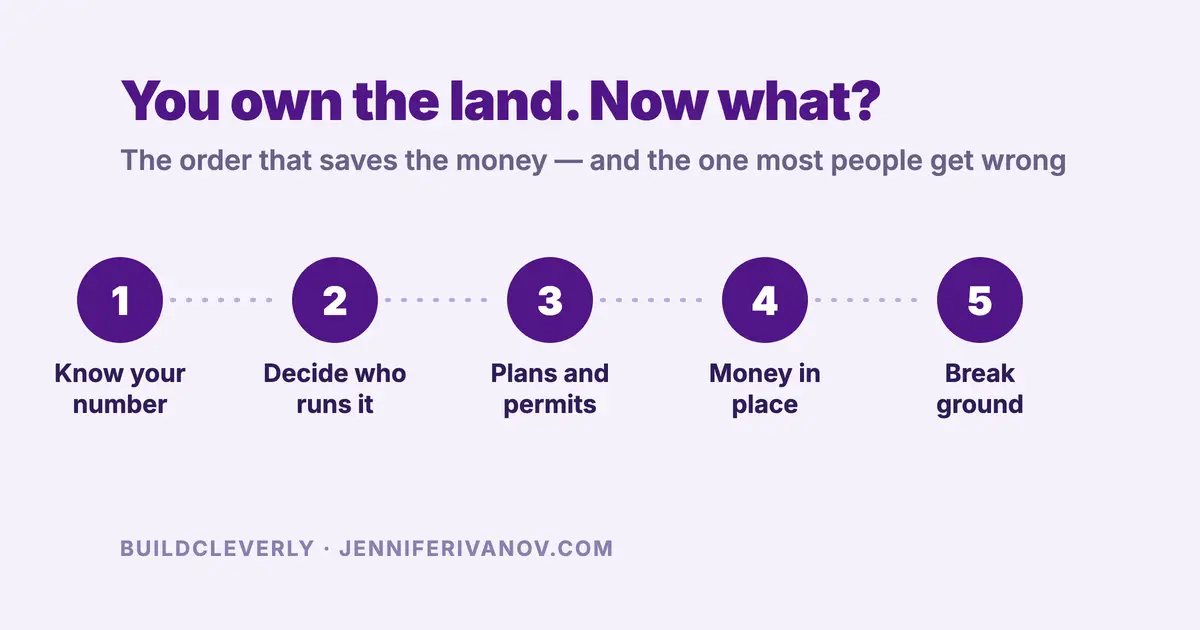
You bought the lot. That was the hard part, and it is done.
Most people think the next step is a builder. It is not. The next step is a calendar, and almost nobody tells you that until it is too late.

The thing to do first
In most places worth building in, the good contractors are booked a year or more out. Where I am, in Park County, Wyoming, it runs 12 to 18 months.
Read that again, because it changes your whole order of operations. If you wait until your plans are finished to start calling, you have not started a build. You have started a wait.
The one who can start next month is usually the one with a gap in his schedule. There is sometimes a good reason for that gap. You will pay his number anyway, because what else are you going to do.
Find out what the wait is where you are, this week, by calling and asking. If you are hiring one builder to run the job, call three of them. If you are running it yourself, it is three trade contractors for each phase, and you start with the ones you need first. It is a two-minute call either way, and it will reorder everything else you were planning to do.
Then get in line. You can take a place in line before you have a final plan. You cannot get a plan built by a crew that does not exist.
Who is going to run the build?
Decide this early, because it changes everything else, including whose schedule you need to be on.
Hire one builder to run the whole thing. A general contractor handles the schedule, hires the trades and hands you a finished house. One contract, one phone number, one person answerable for it. You pay a premium for that, and for a lot of people it is worth every cent.
Run it yourself as an owner-builder. You contract each trade directly. I have seen this take 20 to 25 percent off a build, which on any real budget is a great deal of money. You are also the one chasing schedules, checking work, and working out what to do when the framer runs late and the electrician is already booked somewhere else. It is a real job, not a weekend one.
Or somewhere in between. Hire a builder for the house itself and handle some of the rest yourself.
One piece of wording that trips people up. When a general contractor is in charge, the other trades are called subcontractors, because they work under him. If you are the owner-builder, there is nobody above them, so you are contracting with trade contractors directly. Same people, different relationship. And it matters, because whoever holds those contracts is the one responsible for them. As an owner-builder, that is you.
It also changes the advice above. With a general contractor you are joining one schedule. As an owner-builder you are joining several, and they have to line up in the right order.
Never let the payments get ahead of the work
This is the most important thing on this page, so it gets its own heading.
Do not pay money to get on a schedule. Do not pay money for signing a contract. Signing is not work. A date is not work.
Here is why it matters more than it sounds. A contractor who needs your money before he has done anything is usually using it to finish the last job. That job was paid for by the one before it. It is robbing Peter to pay Paul, and in that cycle somebody always gets shorted. It can just as easily be you.
On a large phase, buy the materials yourself. Order them, pay the supplier directly, have them delivered to your site. Then the material is yours. It is sitting on your land, it cannot be carried off to somebody else's job, and you are not handing over thousands of dollars against a promise.
Pay when a milestone is finished and verified as done correctly. Not when it is nearly done. Not when it is done and nobody has looked. Finished, checked, and right.
Get a lien waiver signed with every payment. It is a short document in which the person being paid gives up the right to put a lien on your property for that work. Without one, a sub or a supplier who never got paid by your contractor can still come after your house, even though you paid your contractor in full. Ask for the waiver at the same moment you hand over the money, every single time.
That is the whole rule, and it protects everybody. A good contractor is paid promptly for work that is actually complete. You never have money sitting out in front of the job with nothing to show for it.
Get it inspected before it gets covered
"Verified as done correctly" means somebody who knows what they are looking at has actually looked.
The test is not simply whether something is structural. It is whether it is structural, whether it is a safety issue, or whether it is about to be covered up. Paint, flooring and tile are none of those. You can see them, you can fix them, and a good handyman can do most of that work. But plenty of things that are not structural still matter: clearances around fixtures, anything to do with gas, anything to do with grounding.
Four points matter more than all the rest.
The foundation, before the pour. Once that concrete is in, it is in. Everything above it inherits whatever is wrong down there, and it is the hardest thing on the whole build to put right afterwards. A pre-pour inspection is not optional in my book.
While you are there, check one thing that gets missed over and over: the Ufer ground. It is an electrical ground formed by the steel or a wire cast into your footing. What happens is the concrete crew shows up and pours, and nobody told the electrician to come and set it first. It costs almost nothing to do before the pour and it is a nuisance to put right afterwards. Make sure your concrete contractor and your electrician have actually spoken before anybody orders concrete.
That is a small example of a much bigger point. If you are running the job yourself, nobody else is making sure two trades talk to each other. That is your job now.
Everything structural. Framing, how the roof is laid, the roof nailing, how the trusses are attached and tied down. This is what holds your house up in wind and snow.
Windows and exterior doors, as they go in. Installed wrong, they leak. Not always right away, and that is exactly what makes it expensive. The flashing and the way each opening is sealed get hidden by siding on the outside and by finishes on the inside. By the time a stain shows up on a wall, water has been getting in quietly for a season or two, and what it has been soaking into is your framing. Have the openings looked at while you can still see how they were done.
Every rough-in, before the drywall. Plumbing, electrical, heating and cooling. There are spacing requirements people get wrong, like how far a toilet rough-in has to sit from the back wall and the side wall. Once that is signed off and the walls close up, you know your fixtures will land where they are supposed to.
After the drywall goes on, most of what is left is cosmetic and you can see it with your own eyes. It is the work that gets covered up that needs somebody looking at it.
Here is the part people miss. If your land is in an unincorporated area where the county does not require inspections, or does not have an inspector at all, that does not mean the work does not need checking. It means nobody is going to do it for you. Hire a private inspector, and do it before you release payment for that phase.
That is what ties the two halves together. You pay when a milestone is finished and verified. This is the verifying.
What happens, and in what order
A build is not one job. It is ten of them, and they go in order. These are the same ten stages the budget tool uses, so the words will match when you get there.
If you hire a general contractor, they run most of these for you. If you are the owner-builder, each one is a contract you hold and a schedule you keep.
1. Land and finance. What you paid for the lot, what is still owed on it, the cash you are putting in, and the loan if you need one.
2. Pre-construction. Plans, engineering, the boundary survey, the soils report, the perc test, permit fees, insurance, title and legal. This stage has no walls to show for it, which is why people rush it. Do not. Everything after it inherits whatever you got wrong here.
3. Site work. The dig, grading, the well, septic or sewer, bringing in power, water and gas, the driveway and road approach, drainage. Your temporary services belong here too: power with receptacles, a dumpster, and a toilet on site. A tidy site is a safe site, and a crew that has to leave to find a restroom is a crew that is not working.
4. Foundation. Footings, structural concrete, flat work, retaining walls, reinforcing steel.
5. Structure. Framing and sheathing, rough lumber, trusses, beams, masonry.
6. Dry-in. Roofing, siding, waterproofing, gutters, windows, exterior doors, garage doors, insulation. This is the stage that gets the weather off your build.
7. Rough-in. Plumbing, electrical, heating and cooling, duct work, the water heater. All of it goes inside the walls.
Nothing gets covered until it has been inspected. There is more on that below, because it is the other half of the payment rule.
8. Interior finishes. Drywall, paint, flooring, tile, counters, cabinets, trim and doors, hardware, appliances, fixtures. This is where budgets go to die.
9. Exterior finish. Driveway paving, walks and patios, landscaping, irrigation, fencing, decks.
10. Closeout. Final clean-up, supervision, overhead, the contractor's management fee, punch list.
What you can cut, and what you cannot
If you are scraping to get the house finished, two stages are where you look.
Interior finishes. You can choose a cheaper counter. You can paint now and tile later.
Exterior finish. This is the most forgiving stage on the list. Landscaping does not need to be lavish, and grass can wait a year. Fencing does not need to run the whole property. A driveway and apron can be minimal and finished properly later. None of it stops you living there.
What you cannot cut is the structure, anything mechanical, and anything an inspector has to sign off. Cutting those is how a build stops being finishable, and it is the most expensive mistake on this page.
What to do in the next 30 days
- Call contractors and ask one question: when is your next opening? Not for a bid. For a date. You are shopping for a place in line.
- Write down a number you can live with, before anyone quotes you anything. A budget you set after the first bid is not a budget, it is a reaction.
- Start the loan conversation if you need one. Ground-up construction is its own kind of lending, and not every bank does it.
Three things that vary by where you are
These change from state to state and sometimes from county to county. The mistake is assuming the version you read online is the version that applies to you.
What materials actually cost near you. Where I build, in Park County, there is no big box lumber yard at all. It is Bloedorn, Builders FirstSource, and smaller local yards. Prices in a rural market with one or two suppliers are not the prices you find online. If you built your budget off numbers from a national site, it is wrong before you start. Call your nearest yard and price your real list.
Who is allowed to do the work. Contractor licensing is a state matter and the rules differ a great deal. Wyoming, for instance, does not license contractors at the state level, with one important exception: electricians are licensed statewide. Where I am, the rule that matters is simpler than people expect – if the work needs a permit, the person doing it needs to be licensed for that trade. Ask your own building department what your specific job needs. Do not go by a dollar figure you heard somewhere, because that is usually not how the rule reads.
What your parcel itself allows. Your land may carry its own recorded covenants, and they can forbid things you assumed were fine. They show up in the title work, so ask the title company and actually read them. This one is not regional. It is per parcel, and it catches people everywhere.
Know your number before you hire
The most useful thing you can do this month is put a number on each of those ten stages, before anyone bids.
I built a free construction budget tool that does it. You enter what you think each stage will cost, then your real bids and contracts as they come in.
You do not need a project posted to use it. Sign in and it saves to your account, so you can sit with the numbers for a week before you decide anything. Nobody else can see them. It shows you where you are over, where you came in under, and what is actually left. It handles the land, the contingency and the loan interest, which are the three things people leave out and then cannot explain later.
If you are borrowing, it works backwards from what the house will be worth and shows you the most the whole project can cost before a lender stops saying yes. If you are paying cash, it skips all of that and just tracks your own money.
I built it because I needed it. Phases came in over, phases came in under, and the only way to stay whole was to move the difference on purpose instead of finding out at the end.
If you already have plans drawn, there is a material takeoff that reads them and works out the quantities — studs, sheathing, concrete, roofing, insulation — so the number you put against each stage starts from something real rather than a guess. It will not size a beam for you; that belongs to whoever engineered your plans. What it will do is stop you forgetting the stem wall.
If you need a construction loan
Ground-up construction is not a mortgage. A lender wants to see what the place will be worth finished, what the whole project costs, how much you are putting in, and how long you expect to take. The budget tool puts those four numbers in one place, which is most of what you will be asked for.
I am not a loan officer and I do not originate loans. But I keep a list of lenders who fund ground-up construction nationwide, including for first-time builders, and I am happy to point you toward it.
Questions people ask
What is the first step to building a house on land?
Getting onto a contractor's schedule. Not plans, not permits, not a shovel.
Everything else on the list can be worked on while you wait. The wait itself cannot be shortened once it has started, and in a lot of markets it is a year or more. So the first call you make is the one asking when somebody's next opening is.
Is it cheaper to build a house on your land?
Sometimes, and it depends almost entirely on the land.
If you already own the lot outright, you have taken the single biggest line off the top, and that is a real advantage. But raw land can hand it straight back. A long driveway, a deep well, an engineered septic, bringing power a distance from the road – any of those can run into real money before a single wall goes up.
Land you already own is a head start. It is not a discount.
Is $100,000 enough to build a house?
It can be, but it has to be a very small and very modest house.
Think 500 to 700 square feet. Think simple shapes, plain materials, nothing custom. You would also need to act as your own general contractor and sub the trades out yourself, which saves a real amount of money and costs a real amount of your time. A small modular home set on a foundation is another way people get there.
One thing to know before you plan around it. In some areas a permanent foundation may not be required. But if you want a bank or a mortgage lender to finance it, it will need to be on a permanent foundation and be part of the real estate. A house that is not attached that way is not something most lenders will lend on.
So the honest answer is that it depends on your square footage, your design, your materials, and how much of the work you are willing to manage yourself. There are ways to cut back. There is no version of it that is roomy.
Why would land not be buildable?
Usually water, waste, access or restrictions. No water you can reach, soil that will not pass a perc test, no legal access to the parcel, or covenants that forbid what you had in mind.
Those are questions to settle before you buy, which is a different page. There is a longer write-up in the buying-land guide. If you already own the lot and one of them is biting, it is worth finding out exactly which one before you spend anything else.
Start with a date, not a shovel
If you take one thing from this page, make it this: call about the schedule this week.
Almost everything else here can be fixed later. A twelve-month wait that started in March instead of January cannot.
I am Jennifer Ivanov, and I am the founder of BuildCleverly, a managed construction marketplace. You post your project once, free, and take bids on it, free. Milestones, payment requests and lien waivers are all built in, so the rule above is just how the thing works rather than something you have to remember.
Contractors from outside your immediate area can see your project too, which matters a great deal when everyone local is booked.
Three things you can do today
Work out your number. Open the construction budget tool and put a figure on each of the ten stages. Free, and you do not need a project to start.
Find out what the wait is. Three calls. Ask when the next opening is, not for a price.
Post your project and let the bids come to you. Create an account as a homeowner, put your job up, and see what comes back. It costs nothing to find out.
Or look around first and post nothing at all. You can see the contractors who are on there, and the projects already posted, without an account.
Need to finance it? Ground-up construction lending works nothing like a mortgage on a house you will live in. Here is what loan to cost and loan to value actually mean, and what it takes to build with none of your own money: Construction loans for first-time builders.