
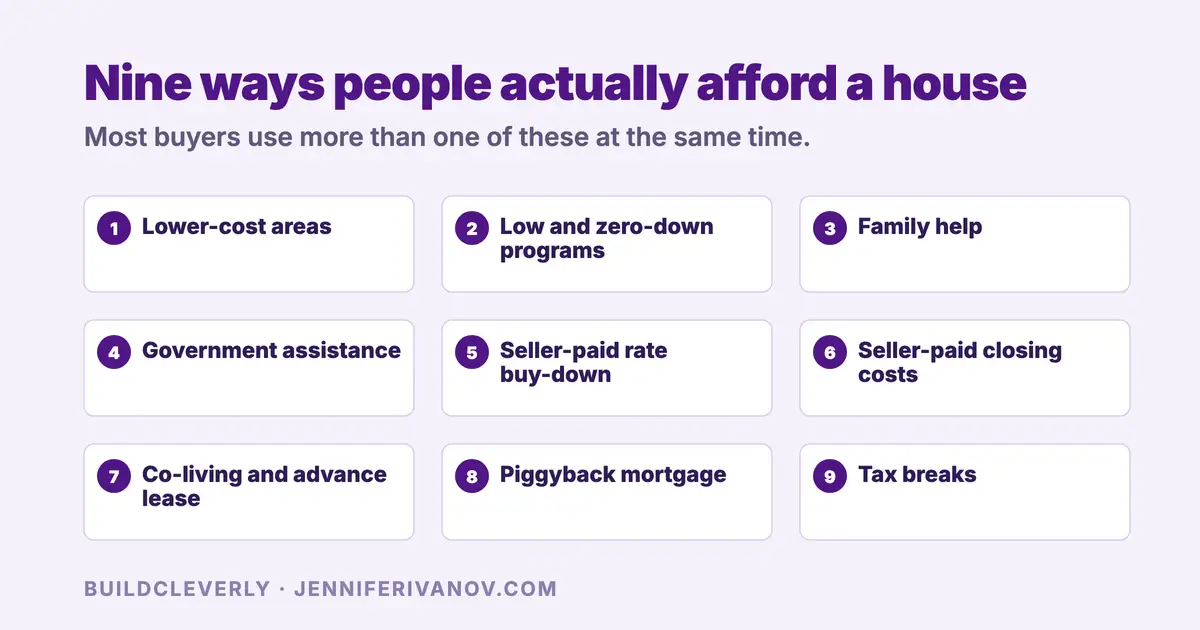
Home prices are always in flux, but when they are high, makes one wonder how do people afford houses? It can be especially difficult for first-time buyers to afford a home. In some cases, even those with a great job and steady income might struggle. Making a down payment or coming up with other necessary funds such as closing costs can be tough.

So how are people suppose to afford houses? These 17 creative tricks may reveal how to afford buying a home and get your foot in the door. Even when home prices are high!
1. Look for Homes in Lower-Cost Areas
How do people afford houses, you ask? Looking for homes in lower cost areas should be a tip-top ideal solution on your list. In fact, this is how I began my homeownership journey! Especially if you are fortunate enough to work remotely and do not need to commute to an office.
If you’re willing to look outside of the most expensive areas which are typically within or near to urban areas, you may be able to find a home for a lower price. Often it may mean looking only in a 50 to 100 mile parameter.
This can be a great way to save money on the purchase and keep your monthly payments within your budget and close to what you’ve already been paying for rent. I call this your “stepping stone” to homeownership, the start of your path to building equity and to bigger and better options in the future.
2. Explore Zero-Down & Low-Down Payment Programs
If your monthly budget isn’t a problem, however you have little or no money saved for a down payment and a fair credit score, many lenders offer no-down and low-down payment programs that require as little as 0% for USDA, 0% for VA and 3.5% for FHA. This could be a great way to save on the cash needed to buy a home.
Each of these government backed programs have their own qualifying guidelines, but are the least stringent on down payment, credit scores and debt to income ratios. Did you know that USDA is NOT just for rural areas? This is a wide misconception. Most suburban areas are located within the USDA lending parameters.
Don’t hesitate talking to a mortgage lender familiar with these types of loan programs, you may be pleasantly surprised! How are people affording houses? This should be another top option on your list!
3. Ask Your Family for Help
How do people afford houses? With help from family! Help from family has often become a big solution. It is becoming more common for family members to help out with the cost of buying a home. Don’t be shy to ask.
If you have family members with extra money, they might be able to help out with the down payment or associated closing costs. Some mortgage programs such as FHA allow gift funds toward the down payment.
4. Look for Government Assistance
There are many government programs that can help with the cost of buying a home. It is worth researching what is available in your area.
5. Mortgage Rate Buy Down: Seller Contribution
If the seller, builder or lender is willing to contribute to the purchase, they can help lower the interest rate for your mortgage. This is called a mortgage rate buy down seller or lender concession. There are permanent buy downs as well as temporary buy downs.
Typical buy down arrangement in a high priced housing market are 3-2-1, 2-1 and 1-0 buy downs that can help lower the interest rate cost and the monthly payment for the first three, two or one year respectively. It can be a great way to make the purchase more affordable and help lower your initial monthly debt. Be aware that although this can achieve temporary relief will affect negotiations of your overall deal and actual interest note rate.
6. Closing Cost Seller Contribution
This is HUGE and may drastically solve the quandary of “how do people afford houses”? If you are short on closing cost funds needed to get in. If the Seller is willing to contribute toward the purchase (which often they are), they can help fund your deal by covering some or all of the closing costs.
This is a great way to make the purchase more affordable by covering an otherwise large out of pocket expense. Typically the Seller will negotiate a high purchase price in order to compensate for their contribution, making their net proceeds the same. In this scenario you are financing your closing costs which also means the property must appraise high enough to cover the upward adjusted price. This could be a great option if one, you don’t have the extra cash to close the deal, or two, you could use the extra money to pay off debt and lower your monthly obligations which will bring your DTI (debt to income) ratio lower.
7. Co-Living Advance Lease Agreements
If you’re planning on renting out a room in the home, you may be able use the advance rent payments from your tenants to help foot the down payment, closing costs or qualify for better mortgage terms.
This can help reduce the amount of money you have to pay each month, making the purchase more affordable. If looking for a place to advertise your rental, be sure to check out the top three short term rental platforms. Talk to your mortgage lender to discuss if this is a viable option for you.
8. Consider a Piggyback Mortgage
If you don’t have enough money saved up for a down payment and your goal is to eliminate PMI, you can consider a piggyback mortgage. This is when you take out a second loan to cover the a portion of the down payment, allowing you to avoid paying PMI (private mortgage insurance). Piggyback mortgages are typically structured as an 80-10-10 or 80-15-5. An 80-10-10 represents an 80% 1st mortgage, 10% 2nd mortgage and requires a 10% down payment.Likewise the 80-15-5 represents 80% 1st mortgage, 15% 2nd mortgage and requires a 5% down payment. Although it is always good to avoid having to pay PMI whenever possible, it is best to review these scenarios with your mortgage lender to be sure a Piggyback mortgage is in your best interest.
9. Utilize Tax Breaks
There are certain tax breaks available for homeowners, such as the mortgage interest deduction and property tax deductions. These can help lower the overall cost of ownership, making the purchase more affordable.
Did you know that changing your withholdings can net you more back from your paychecks? This means more in your pocket to use toward mortgage payments. This extra monthly income can help considerably. Talk to a qualified tax advisor to discuss the possibilities and benefits.
10. Look for Foreclosures
Foreclosed homes can be a great deal, and they can be much more affordable than non-foreclosed homes. Sadly these homes have been lost by the previous owner by defaulting on their mortgage and currently being sold by either the bank, HUD, VA, Fannie Mae, Freddie Mac etc.
These Sellers are not in the business to own homes and are highly motivated to get them off their books. The drawback is that they are typically sold in “as is” condition and can be hard fixers needing major repairs. The Seller will not typically make or credit for repairs.
11. Consider Fixer-Uppers
Fixer-uppers are often much more affordable than move-in ready homes. If you are willing to do some work on the home, it could be a great way to save money. However, if the home is a hard fixer-upper, a lender may not make the loan as both the borrower as well as the property must quality. Check out the FHA 203k renovation loan that allows for repairs on owner-occupied purchases.
12. Consider Rent-to-Own
Rent to own homes are most typical in a buyer’s market when the seller is up against heavy competition of other listings and is a way to make a deal in a difficult or stagnant market by enticing buyers that cannot otherwise currently qualify for a home loan.
The buyer Rent-to-Own agreements can be a great way to build equity in a home while renting it. The seller retains legal title while the buyer retains equitable title. This could be a great way to eventually afford to purchase a home, but can be risky.
13. Look for Homes With Low Property Taxes
Property taxes can add to the cost of buying a home. Property tax rates can vary city to city and county to county. It is worth researching which areas and homes have the lowest property taxes. For example, property tax in Los Angeles County is 1.25% whereas just further north Kern County is only 1%.
14. Examine Your Credit Score
If you have a high credit score, you might be able to qualify for a better interest rate, which could make buying a home more affordable. The higher your credit score the better chances of a lower interest rate which means a lower monthly payment.
If you have just begun your credit building journey, have little or no credit profile or need to rebuild credit, opening a credit card, whether secured, un-secured or other credit building solutions can help bump your credit score, credit history and increase the chances for qualifying when paid timely and managed responsibly.
15. Look for Non-Traditional Lenders
Some lenders have more flexible requirements when it comes to credit scores and income. It might be possible to find a lender in your area that has less stringent underwriting guidelines. This is typically when they plan to keep the loan in house and not sell the loan on the secondary mortgage market. They may just offer a loan tailored to your specific situation.
16. Tap Into Your Retirement Savings
It is possible to take money out of a 401(k) or other retirement accounts to help with a down payment. This could be a great way to make the home more affordable. Talk to your tax advisor.
17. Combining Multiple Affordable Options
The Ultimate Solution: How Do People Afford Houses? Use the preceding options by combining the benefits that can help with your situation. For example, if you choose an FHA loan and a family member gifts you 3 1/2% for the down payment. Plus you negotiate an offer on a home where the Seller agrees to contribute toward your closing costs.
There you have it, you get in with zero out of pocket! You may even ask the Seller to contribute toward a 2/1 Buydown of your interest rate. Keep in mind there are limitations associated with each loan program, so be sure to review all your options with your mortgage lender. All programs are unique, come with their own set of guidelines and continually change.
Conclusion
Buying a home can be a daunting task, especially when home prices are at an all-time high. However, with a few tricks and creative planning, it is possible to make the purchase affordable. Try out some of these 17 creative ways to finance your home purchase including renting out a room for income. You may be surprised at what you can afford and crack the code to the question: how do people afford houses? I think you’ve got this!
Frequently Asked Questions: How Do People Afford Houses?
1. Will Gen Z be able to afford houses?
Although buying a home has become more difficult for younger generations, Gen Zers are finding the way by building a good credit history, minimizing debt and considering lower cost areas to buy their first home by taking the stepping-stone approach to homeownership.
2. How much house can I afford if I make $70,000 a year?
Assuming no additional debt, using a 40% debt to income ratio, low 3 1/2 % down payment or gift funds from family, seller paid closing costs and a 6% mortgage interest rate, a pre-tax gross income of $70,000 should get you a mortgage loan and home price of roughly $300,000. Keep in mind in the event you have a down payment, the home price can be higher, equalling the amount of down payment you have. For instance if you have $20,000 saved for a down payment, your home price can open up as high as $320,000. After putting the $20,000 down, your loan amount will remain the same at $300,000.
3. How do people afford a 300K house?
To afford a house with a price tag of $300k at 6% interest, you’ll need a minimum fair credit history and score of 580 to 669, low 3 1/2% or no money down, have little or no other debt and an income of $70,000 a year. If you have additional debt, you will need more income to offset the monthly expense of the debt by roughly 2.5 times. For example if you have $500 per month of additional debt, you will need additional income of roughly $1250 monthly or $15,000 more per year. It’s easy to see how a large car payment can be a deal breaker when needing to qualify for a mortgage loan!

Author: Jennifer Ivanov
Jennifer Ivanov built spec homes in California before moving to Wyoming, and has built homes here. She has valued property as an appraiser, arranged financing as a mortgage broker, and represented buyers and sellers as a licensed broker. California DRE Lic #00993276.
Buying in Wyoming? Get the Wyoming Buyer Protection Checklist — 124 things to check before you close.